

The Currency of Life
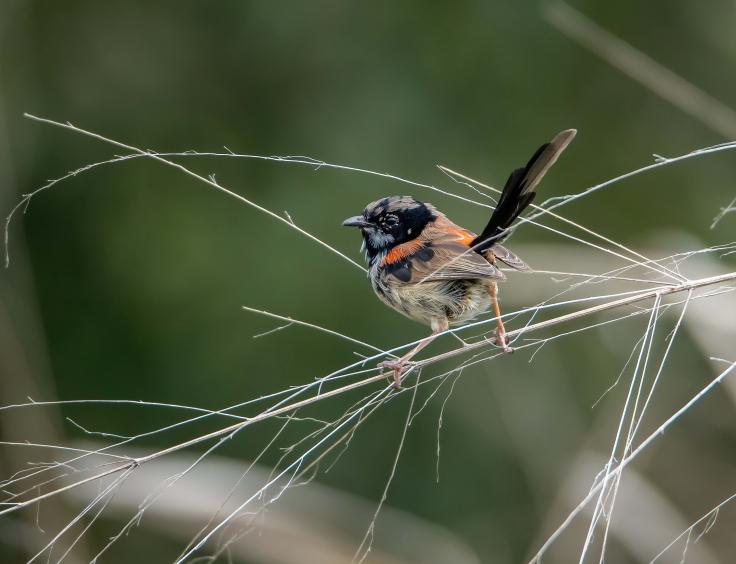
Some years ago, I was sent a photograph of a little red wren and I smiled.
Look at those legs. Those fine, spindly little things are almost indistinguishable from the twigs supporting him. His tiny feet grip the branches, his feathers ruffle, and his tail points skywards. He's so delicate that you almost wonder how something so small manages to negotiate the world at all.
And yet, there he is. Living.
That's what makes this photograph so much more than a pretty picture. It's the contrast between fragility and the sheer persistence of life.
We humans tend to equate strength with size, power, money and control. But here's this little creature, weighing next to nothing, going about his business without any grand display of strength.
He doesn't look invincible. He doesn't expect to be. He probably doesn't even know what invincible means.
There it was, this pretty, delicate little creature, hopping about and doing what it did best. It seemed blissfully unaware of all the things that occupy the minds of us humans. No grand plan. No five-year strategy. No worrying about what tomorrow might bring.
Just a little bird getting on with being a bird.
I wonder sometimes how we humans have managed to make life so complicated.
Look at that little bird again. It's doing what it needs to do. Finding food, drinking water, chirping away and getting on with things.
There is something rather comforting about that really.
I see photographs of cats and dogs romping about, sleeping in the sunshine and generally enjoying the magnificent business of being alive. They seem to have mastered something that we, with all our cleverness, occasionally struggle to understand.
How to enjoy the day we're actually living. Much like our kids used to do before they were told to be woke.
When I wake in the morning, I might be lucky enough to see a bush turkey rummaging around, checking out the breakfast menu for a few promising grubs. Hopefully not destined to be on Dusty McFookit's lunch plate.
I might hear the kids heading off to school and laughing with their friends.
Or a lorikeet might cruise in for the early morning nectar buffet provided by the bottlebrushes outside my small unit. The crows will probably have announced the arrival of dawn long before I am ready to appreciate it.
And, if fortune really has it in for me, a gecko will have decided to share my home overnight, racing around the walls and squeaking its little head off while I try to get some sleep. Noisy little buggers as we all well know.
Nature, it seems, has very little regard for my timetable. Much like my bladder.
While we humans occupy ourselves with our troubles, our niggles, the natural world carries on. Birds sing, dolphins dive, whales migrate, flowers bloom and dogs and cats find the sunniest patch of floor available for an afternoon snooze.
Life goes on.
Of course, nature isn't always gentle. Storms arrive, earthquakes shake the ground and droughts bring hardship. Animals struggle, and not every living thing survives. Anyone who has watched a bushfire or stood beneath a sky darkened by approaching storms knows that nature can be a formidable opponent.
But even after the storm, life begins again.

A plant pushes through the soil. A bird searches for food. Somewhere, a new leaf unfolds.
And we humans? We can spend an extraordinary amount of time worrying about what might happen next.
We worry about money, our health, the cost of living, the state of the world and what the future might hold. Some of those concerns are perfectly reasonable. Life can be difficult, and pretending otherwise would be foolish.
But there is a difference between being alert and allowing worry to consume the very life we're trying to protect.
When did we become so busy preparing for tomorrow that we forgot to enjoy today?

Perhaps it's time to take a lesson from that little wren.
Not because it knows some great secret, or because the natural world is free from hardship. Rather, because life, for all its fragility, is still happening around us.
The sun still rises. The flowers still open. The birds still sing.
And the gecko, bugger it, still squeaks.
Money enters the picture rather more often than we'd like, too. We worry about having enough to live on, enough to pay the bills.
Money matters. Anyone who has had to count the pennies at the supermarket knows that.
But money is a means to an end. It isn't the end itself.
We can spend so much of our lives trying to secure the future that we leave precious little time to appreciate the present. We can become so concerned with what we might lose that we overlook what we already have.
A cup of tea in the morning sunshine.
The sound of rain on the roof.
A phone call from someone we love.
A bird hopping about outside the window.

Small things, perhaps. But small things have a habit of becoming very large in our memories.
I sometimes wonder whether we've lost sight of the difference between the price of something and its value, as we have discussed before. A house has a market value. A familiar voice on the phone does not, yet the latter can rearrange an entire day in ways the former rarely does. The difficulty is that the systems we live inside are very good at converting almost everything into the first category and very poor at protecting space for the second.
But how much is a sunrise worth?
What is the monetary value of hearing a familiar voice, watching a child laugh or seeing a butterfly settle on a flower?
We know the answer, of course. There isn't one.
Their value doesn't lie in what they cost. It lies in what they mean to us.
Perhaps that's where the natural world has something to teach us. Not that money is unimportant, or that we should abandon our responsibilities, but that there are things of value that money cannot measure.

Consider the humble butterfly. Its life may be brief, yet it flutters from flower to flower, playing its part in the extraordinary business of keeping the natural world going.
A crow, so often regarded as a nuisance, can help clean up a roadside by feeding on what has been left behind. What one creature has lost may help another survive.
Everywhere we look, life is connected to life.
We humans are part of that story, too, although we sometimes behave as though we've somehow been exempted from it.

We are born. We grow. We love, work, laugh, grieve and grow old. We make mistakes, learn a few things and, if we're fortunate, leave something worthwhile behind.
The years pass whether we're worrying or laughing. The days come and go whether we're watching the news or watching the birds.
We don't get to choose everything that happens to us. We do, however, have some say in where we place our attention.

And sometimes, that is enough to make a difference.
So, the next time a bird lands nearby, take a moment to watch it.
Watch the way it moves, the way it searches for food, the way it goes about its business without any fuss or ceremony.
Listen to the morning birdsong.
And if a gecko decides to hold a midnight concert on your bedroom wall, try to remember that it's only doing what geckos do.
Although, in that particular case, being pissed off may be entirely justified.
We spend so much time thinking about the grand questions of existence that we sometimes overlook the small pleasures that make existence worthwhile.
Perhaps we don't need to solve every problem in the world before we can enjoy a beautiful morning.
Perhaps we don't need to know exactly what tomorrow holds before we can be grateful for today.
And perhaps the little red wren had something to teach me after all.
Its life, like ours, is finite. It doesn't know how long it has, and neither do we.
But here it is, hopping about in the sunshine, making the most of the day.
I think there's a lesson in that.
Death will come when it comes. Until then, we have a life to live. We may as well get on with it.
The little wren does not solve this. It just keeps living without the extra thinking.
Perhaps their currency is life itself.
Shaydee

BLOG COMMENTS POWERED BY DISQUS


