

The Warning of Gareth Jones: Who Owns Our Land, Our Water, Our Future?
When we speak of Ukraine and Russia in the 1930s, we are speaking of lands under Stalin’s Soviet regime - not the independent nations they are today.
It was this regime that forced millions of peasants into collectivisation from 1929 onwards, stripping them of land, property and independence. This was not simply a natural disaster. Government policy - including forced collectivisation, crushing grain requisitions and confiscation of food - helped create the conditions for catastrophe and was used to break resistance to Soviet rule.
In Soviet Ukraine, around four million people died during the famine of 1932–34, according to demographic estimates cited by the Encyclopedia of Ukraine. Millions more died in other parts of the Soviet Union, particularly Kazakhstan and parts of Soviet Russia.
By 1932 and 1933, grain requisitioning and confiscation had become relentless. In Ukraine, Soviet authorities intensified searches for food, confiscated grain and other foodstuffs, and eventually restricted the movement of starving peasants attempting to escape the famine. The result was mass starvation on a horrifying scale.
Timothy Snyder, in Bloodlands, described the horror:
“The good people died first. Those who refused to steal or to prostitute themselves died. Those who gave food to others died. Those who refused to eat corpses died.”
It was not simply a famine caused by weather or bad luck.
Government policy helped create the conditions, and the machinery of the Soviet state intensified the suffering. Hunger became an instrument of control.
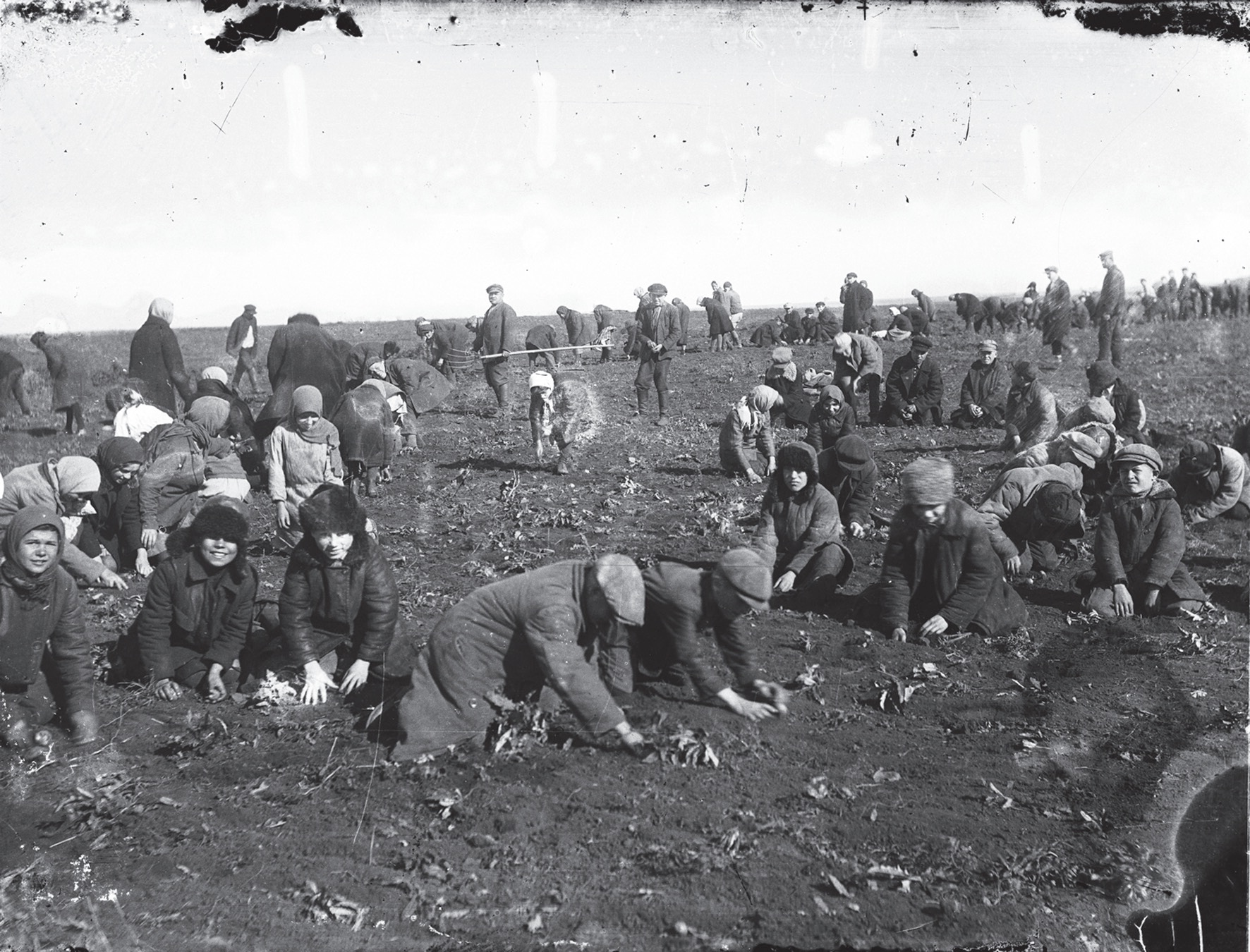
The Welshman Who Told the Truth
The outside world was not completely unaware of what was happening, but access to the Soviet countryside was restricted and the famine was denied or downplayed by influential Western correspondents. Walter Duranty of The New York Times was among those who rejected reports of famine. He had won the 1932 Pulitzer Prize for his reporting on the Soviet Union. The Pulitzer Board later concluded that his prize-winning 1931 work fell seriously short by modern standards, although it declined to revoke the award because it found insufficient evidence that the specific articles submitted for the prize met its standard for deliberate deception.
But one man refused to simply accept the official story: Gareth Jones, a young Welsh journalist.
In March 1933, Jones travelled through Soviet Ukraine despite foreign correspondents being forbidden to visit the countryside. He walked from village to village and spoke directly with starving peasants. He saw empty villages, desperate hunger and people waiting for death. His own contemporary reporting recorded the cry that became associated with his investigation:
“There is no bread: we are dying.”

When Jones returned to Europe, he held press conferences and published his account of what he had seen:
“Everywhere was the cry, ‘There is no bread. We are dying.’ This cry came from every part of the Soviet Union.”
Jones was attacked by Soviet officials and publicly denounced by some Western journalists. He was subsequently barred from returning to the Soviet Union.
In 1935, while investigating Japanese expansion in the Far East, Jones was kidnapped and murdered by bandits in Inner Mongolia. There were suspicions of political involvement, including possible Japanese or Soviet involvement, but the precise circumstances surrounding his death remain disputed.
Gareth Jones stood as a witness - and paid with his life. His lesson remains clear: sometimes the important question is not whether an official story is convenient, but whether somebody has actually gone and looked.
The question is whether we listen.
The Australian Parallel
Australia is no stranger to hardship. Our farmers battle drought, flood and fire. But increasingly, questions of land, water, food production and foreign ownership have become questions of policy as well as weather.
Australian water markets did not suddenly appear with the Water Act 2007. Water trading had been developing since the 1980s, with major reforms through the 1990s and early 2000s. One of the formative changes was the separation of water rights from land ownership, allowing water entitlements to be bought and sold independently of land title. The 2007 Commonwealth Water Act became an important part of the national framework governing the Murray–Darling Basin and its water markets.
That distinction matters. Water entitlements are now recognised as separate, tradeable rights. In New South Wales, for example, a water access licence is listed separately from land ownership and provides increased opportunities to trade water.

And foreign ownership is not a matter of imagination. The Australian Taxation Office reported that, at 30 June 2023, 12.9% of Australian agricultural land had some level of foreign ownership. The corresponding figure for water entitlements was 11.8%, up from 11.3% the previous year. These figures measure any level of foreign ownership and do not mean that foreign investors control those entire assets outright.
Since then, the pressure on Australian agriculture has continued to raise difficult questions:
-
Family farms face rising costs, debt, drought, flood and increasing competition for land and water.
-
Dairy farming and other traditional agricultural industries have faced years of pressure from production costs, market structures and changing consumer prices.
-
Food prices can rise sharply while the farmer producing the food does not necessarily receive a corresponding increase in income.
-
Farmland increasingly competes with other uses, including renewable-energy projects and associated infrastructure, raising questions about how much productive agricultural land Australia should commit to competing priorities.
When drought hits, farmers can find themselves carrying the consequences of decisions made far beyond the farm gate. Governments provide assistance, but relief does not necessarily restore a farm that has lost its stock, its water security or generations of accumulated capital.
The Global Picture
The world in 2026 is hardly a picture of certainty. Wars, geopolitical tensions, disrupted supply chains and energy and food-security concerns have reminded Western nations that abundance cannot simply be assumed.
Australia is a wealthy agricultural nation, but wealth does not automatically equal self-reliance. Foreign investment in Australian land and water is real, and Australian governments have systems for recording and regulating such investment. The ATO now maintains the Register of Foreign Ownership of Australian Assets, which includes agricultural land and registrable water interests.
The question is not whether every foreign investment is bad. Nor is it whether Australia should shut itself off from the world. The question is much simpler:
At what point does dependence on other people's capital, markets or infrastructure begin to compromise a nation's ability to feed and sustain itself?
Form and Effect: The Warning Remains
The Holodomor was a catastrophe of an entirely different order. Stalin's Soviet Union was a totalitarian dictatorship. Millions starved under a system of coercion, confiscation, repression and state control. Australia is a democratic country. Australian farmers are not facing soldiers at the door demanding the family's last sack of grain.
But the circumstances do not have to be identical for the warning to be worth hearing.
The modern danger, if there is one, would come in a very different form: market dependence, foreign investment, policy decisions, concentration of ownership and centralised control over essential resources.
The potential effect is not famine by Stalin's methods. It is something more gradual: farmers losing economic independence, communities losing productive land, water becoming increasingly detached from the land that depends upon it, and a nation becoming less capable of determining its own food future.
That is a very different proposition from the Holodomor. But it is precisely why history matters. We do not study catastrophes merely to look backwards at the dead. We study them so that we recognise warning signs when they appear in a different form.
Gareth Jones walked through starving villages and carried their story to the world. He saw what others had not seen - or did not want to see - and told people what he had found.
He went and looked.
Today we do not need to walk through empty Ukrainian villages to ask the questions that matter here at home.
Who owns our land?
Who controls our water?
Who controls the infrastructure on which our food production depends?
And how much control are we prepared to surrender before we discover that ownership on paper and sovereignty in practice are not necessarily the same thing?
Gareth Jones's warning was not simply about famine.
It was about what happens when people stop asking questions, when official assurances replace observation, and when warnings are dismissed because the consequences have not yet arrived at the front door.
The warning is here. The question is whether we will listen.
BLOG COMMENTS POWERED BY DISQUS


