

The Alfred Graving Dock - a monument to Victorian engineering and Australian shipbuilding
Most readers have probably never heard of the Alfred Graving Dock.
Indeed, I suspect many would quite reasonably ask: “What is a graving dock?”
The answer is rather more interesting than the name suggests.
There is an interesting piece of language hidden in the name. “Graving” is an old word associated with digging, cutting or carving. A grave, in its original sense, was simply a hole dug into the earth, while to grave something was to cut or carve into it , hence engraving. A graving dock is therefore, quite literally, a dock that has been dug or carved out of the ground.
One of Australia's finest examples is the Alfred Graving Dock at Williamstown in Melbourne.
And it is quite a remarkable place.
Williamstown could fairly be described as one of the cradles of Melbourne's ; and indeed Victoria's, history. Its importance began to grow enormously during the gold rushes of the 1850s, when Victoria suddenly became one of the wealthiest parts of the British Empire.
The goldfields around Ballarat and Bendigo were attracting people, ships and money from all over the world.
Melbourne was booming.
And the colonial government had another concern.
What if somebody decided to take advantage of all that wealth?
Britain's naval power was formidable, but Britain was half a world away. If naval vessels stationed in Australian waters required major repairs, they could not simply sail back to England every time something went wrong.
The Colonial Office therefore wanted to know what Victoria intended to provide for its own defence.
One answer was a major dry dock.
If Britain was going to maintain a naval presence in Australian waters, Australia needed the ability to maintain those ships here.
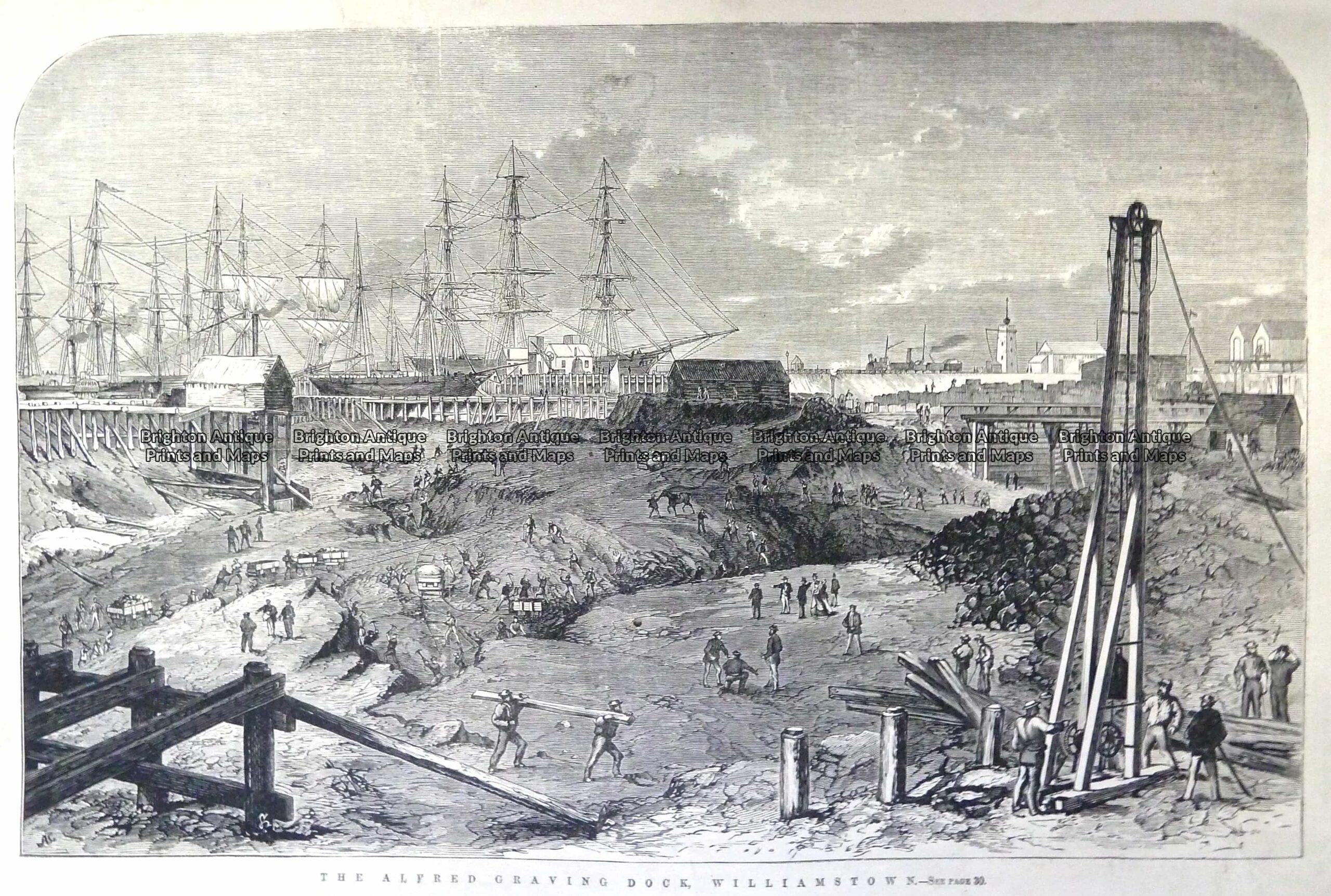
And so, in 1868, construction of the Alfred Graving Dock began. The location presented a rather substantial problem.
Williamstown and much of Melbourne's western suburbs sit upon the enormous basalt plain created by volcanic activity millions of years ago. The ground beneath the workers' feet was not conveniently soft earth waiting to be dug away.
It was rock.
Fortunately, Victoria had no shortage of suitable basalt. Much of the stone required for the dock could be obtained locally.
What followed was an extraordinary feat of engineering.
There were no excavators. No bulldozers. No mechanical rock breakers.No laser levels.
There were men with picks, shovels and wheelbarrows.
Some 72,000 cubic yards of material had to be removed. It was dug, lifted, loaded, wheeled and carted away by hand and by horse-drawn dray.
Construction took six years.
The Alfred Graving Dock was completed in 1874 at a cost of approximately £300,000 , an enormous sum at the time.
It was officially opened by Prince Alfred, Duke of Edinburgh, a son of Queen Victoria, after whom the dock was named.
And what these Victorian engineers had created was extraordinary.
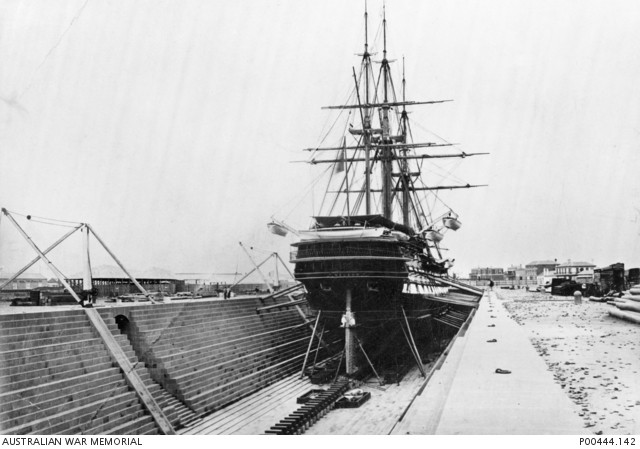
The dock was 469 feet long, 79 feet wide and 26 feet deep, making it the largest dry dock in the Southern Hemisphere at the time.
But the sheer size of it is not what impresses me most.It is the workmanship.
The walls were constructed from individually dressed blocks of basalt. Stonemasons shaped the blocks so accurately that they could be fitted together with remarkable precision, while the levels throughout the dock had to be established without the sophisticated surveying and measuring equipment we take for granted today.
There is something almost humbling about that.
When the dock is emptied, the carefully constructed steps emerge from the water in remarkably uniform sequence along its length.
This was engineering accomplished with mathematics, craftsmanship and extraordinary patience.
And it was done by men using tools that would look primitive to us.
Yet what they built has survived for more than 150 years.
The first major warship to undergo work at the dock was HMVS Nelson, an elderly former Royal Navy warship which had originally been built in 1814. She was progressively reduced from her original three-deck configuration and eventually served the Victorian government.
In those gold-rush years, Williamstown was a forest of masts and spars.
Ships arrived carrying immigrants, supplies and hopeful prospectors. Some crews abandoned their vessels and headed for the goldfields themselves. For a time, the waterfront was crowded with ships of every description.
Williamstown was Melbourne's principal maritime gateway.
And the Alfred Graving Dock became an important part of the machinery that supported it.
The dock was used not only for repairs and maintenance but also as part of the wider shipbuilding industry that developed at Williamstown.
Over the decades, the Williamstown yards produced a remarkable array of vessels for Australia, particularly during the Second World War. Destroyers, corvettes, frigates and other naval vessels were constructed there, contributing to the expansion of the Royal Australian Navy and Australia's wartime industrial effort.
As well as maintenance and repair, there was a steady stream of new ship construction, mainly naval vessels. Over the years but especially starting in 1941, over 30 ships were constructed for the RAN. These included the tribal class destroyers, many corvettes and the ANZAC Frigates, The last one constructed was HMAS Adelaide in 1957. One of two helicopter landing ships with hulls built in Spain.The story of the dock is also the story of the changing ownership and purpose of the wider Williamstown naval complex.
In 1913 the facility became known as the State Shipbuilding Yard. During the First World War it was requisitioned by the Commonwealth, before eventually being returned to the Melbourne Harbour Trust, which used the facilities for shipbuilding and the construction of tugboats.
During the Second World War the Commonwealth again took control, and the complex became HM Naval Dockyard Williamstown.
For generations, Williamstown was home to men who knew how to build, repair and maintain ships.
It was a place where trades were learned and passed from one generation to another.
Shipwrights.Boilermakers.Engineers.Welders.Fitters.Electricians.Riggers.Painters.Machinists.
The list goes on.
These were not simply jobs. They were skills, and skills accumulated over generations become something much more valuable than the sum of their parts.
They become an industrial capability.

In 1987 the Commonwealth sold the facility to Tenix, which subsequently became part of BAE Systems.
And that brings us to the rather less inspiring part of the story.
Australia once possessed substantial shipbuilding capabilities at Williamstown, Whyalla, Sydney and Brisbane. We had the yards, the machinery, the engineers and, perhaps most importantly, the accumulated knowledge of generations of skilled tradesmen.
Much of that capability has been allowed to decline.
Government after government has struggled to maintain a consistent national shipbuilding strategy, while decisions about where defence work should be undertaken have increasingly been influenced by politics, economics and competing state interests.
Meanwhile, facilities that once represented Australia's industrial strength have been allowed to fall into disuse or have been repurposed.
The dock is not simply an old hole in the ground. It is a monument. It represents what can be achieved when a country decides that it needs something, commits the resources to build it and possesses the skilled people capable of doing the work.
The men who began digging that dock in 1868 could hardly have imagined that their work would still be there more than a century and a half later.They had no computers.No modern surveying equipment. No earthmoving machinery.
They had picks, shovels, horses, stone and their own ingenuity.
And they built something that outlasted them.
Perhaps that is the most important lesson of the Alfred Graving Dock.
A nation can buy ships.It can buy machinery. It can import technology.
But once the skills required to build and maintain those things have disappeared, they are extraordinarily difficult to replace.
The Alfred Graving Dock remains protected as an important heritage site.
It should.
It deserves to be regarded not merely as an old industrial relic but as a national treasure: an extraordinary combination of engineering, craftsmanship and Australian industrial history.
Along with places such as the former Cockatoo Island naval facilities in Sydney Harbour, it stands as a reminder of something we once understood rather better than we do today:
A nation that cannot build and maintain the things upon which its security depends is ultimately dependent upon somebody else.
The Victorians understood that.
They dug a hole in the basalt.
They built a dock.
And from that hole in the ground, Australia began building a navy.
BLOG COMMENTS POWERED BY DISQUS


