

My Great-Uncle Walked the Bulldog Track: Kokoda’s Forgotten Cousin
Family stories often sound small until history catches up with them.
For years, I knew only that my great-uncle had walked out of Wau in early 1942 ahead of the Japanese advance. It was spoken of simply as a hard journey through the jungle - one of those half-remembered wartime tales passed quietly through families.
But the more I researched, the more I realised he had traversed one of the harshest tracks of the Second World War.
The rough trail he followed south through the mountains would soon become a vital Allied lifeline, hacked, blasted, and dragged into existence by Australian engineers and Papuan labourers working in some of the most unforgiving country on Earth.
It was called the Bulldog Track. By 1943, it was destined to become a lifeline for the Allies.

The track took its name from the small settlement of Bulldog on the Lakekamu River at its southern end - itself named after a humble supply launch that once serviced the remote mining camps. Like much of New Guinea history, even the name came not from grandeur, but from the practical realities of men trying to move people and supplies through impossible country.
Wau: A Strategic Outpost Under Siege
In the early months of 1943, Wau was one of the most important Allied outposts in Papua New Guinea. Its airstrip and position near the goldfields made it a prize the Japanese were determined to seize as they pushed inland from Lae and Salamaua.
Australian troops - particularly the 17th Brigade and independent commando units - fought desperately to hold it.
The Battle of Wau in late January 1943 became one of the war’s dramatic moments. Reinforcements were flown directly into combat while Japanese forces pressed close to the airstrip. Some troops reportedly fired from the hip almost as soon as they disembarked from their aircraft.
The Japanese assault was eventually beaten back.
But not everyone could leave by air.
Civilians, miners, support staff, carriers, and some military personnel still had to escape the hard way: south through the mountains on foot.
That route was the Bulldog Track.
Jungle Torture
Roughly 114 kilometres long, the Bulldog Track crossed some of the harshest terrain in Papua. Originally cut by miners during the gold rush years of the 1920s and 1930s, by 1942 it had deteriorated into little more than an overgrown scar winding through jungle, swamp, and mountain ridges.


The track descended south from Wau toward Bulldog on the Lakekamu River, crossing parts of the Owen Stanley Range at elevations over 9,000 feet.
The terrain earned a grim reputation.
Steep ridges. Near-vertical climbs. Constant rain. Knee-deep mud. Leech-infested creeks. Dangerous river crossings. Thick jungle that swallowed light and direction alike.
Men called it “jungle torture.”

someone else's story of the Bulldog track
My great-uncle walked it with minimal supplies. There were no proper support columns. No safe staging posts. No certainty beyond the next ridge.
Most Australians know the Kokoda Track as a symbol of endurance.
Far fewer have heard of the Bulldog - a route every bit as brutal, but largely forgotten today.
From Escape Route to Engineering Miracle
Once Wau was secured, Australian commanders recognised a major vulnerability: the region depended almost entirely on air resupply. In country this difficult, that was a dangerous gamble.
The decision was made to transform the old miners’ track into a rough vehicle road capable of supporting jeeps and supply convoys.
The task fell largely to the 2/1st and 2/2nd Australian Army Field Companies, working alongside Papuan labourers, carriers, and officers from the Australian New Guinea Administrative Unit (ANGAU).
At first, they had almost no heavy machinery.
So they attacked the mountains with picks, axes, shovels, gelignite, and stubbornness.
Progress was agonisingly slow. In some places the men advanced only a few hundred metres a day. They blasted rock faces apart by hand, built corduroy roads from logs laid over swamps, bridged rivers with saplings, and carved switchbacks into impossible slopes.
Later, bulldozers were flown into Wau in pieces, reassembled, and dragged forward through mud that could swallow men to the waist.
The conditions punished everyone equally.
Malaria, dysentery, tropical ulcers, exhaustion, and relentless rain became constant companions. More than 70 percent of the Australian engineers contracted malaria during the project.
The numbers alone tell part of the story.
Around 1,038 Australian engineers worked on the route alongside roughly 1,825 Papuan labourers and another 524 carriers. Construction took close to nine months.
Remarkably, only four Australian engineers were killed during the effort - one crushed in a landslide, one struck by a falling tree, and two killed in accidental explosions.
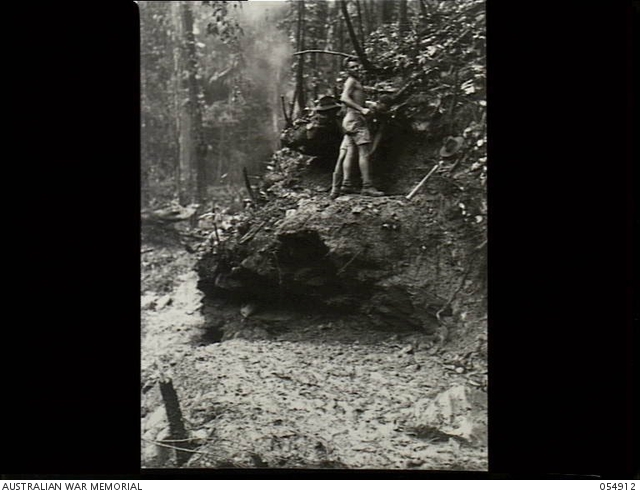
Even the surrounding jungle remained hostile. Kukukuku tribesmen occasionally raided camps for tools, food, and explosives.
Yet despite everything, the road slowly pushed forward.
By August 1943, the first trucks rolled into Wau from the south.
The Bulldog-Wau Road was never elegant. It washed out constantly, collapsed in places, and demanded continuous repair. But it worked.
And in war, “works” is sometimes enough.
The road carried troops, ammunition, fuel, food, and supplies into the mountains, helping sustain further Allied operations against Japanese forces in the region.
More Than Just a Road
The men who built the Bulldog Road were engineers, but they were also pioneers in the truest sense.
They did not simply bridge rivers or cut tracks through jungle.
They bridged geography, logistics, and morale at a moment when every advantage mattered.
Like Kokoda, the campaign depended heavily on Papuan labourers and carriers whose contribution was indispensable, though too often overlooked in postwar memory.
My great-uncle walked that route before it became a road.

Before the corduroy logs.Before the blasted cuttings.Before the bulldozers arrived.
His journey was raw survival.
Theirs was sustained creation under conditions scarcely less brutal.
Today the Bulldog Track remains overshadowed by Kokoda. There are no major films about it. Few Australians could place it on a map. Yet for those who traversed it - whether escaping through the jungle in 1943 or spending months hacking a road through mud and mountain - it represented the raw essence of the New Guinea campaign: human endurance against terrain that seemed determined to defeat it.

When modern discussions turn to “nation-building” and grand infrastructure schemes, I sometimes think of those sappers with their picks, axes, and gelignite deep in the Papua jungle.
They were not theorising.
They were building.
One log.One blast. One painful metre at a time.
And the men who came after him turned his escape route into a lifeline.That, in the end, is the real story of the Bulldog Track.


