

Do We Still Love our Nation to Fight For it?
The Battle of the Bulge was one of the most dramatic and consequential confrontations of the Second World War. It erupted in the dense Ardennes forests during the bitter winter of 1944 - 45, when Nazi Germany launched a surprise offensive in a last, desperate attempt to reverse its fortunes on the Western Front.
The stakes could scarcely have been higher. For the Germans, it was a final gamble. For the Allies, it was a test of endurance that would determine how - and how quickly - the war in Europe would end.
Of course, it is easy to ask, and quite validly too, how can a battle fought on foreign soil be so important? After all, those GIs in the frozen foxholes of the Ardennes were thousands of miles from home, in a foreign land (Belgium and Luxembourg) that most had never heard of before the war. They weren't repelling an invasion on American soil. Yet the prevailing understanding - then and now - is that they were fighting for their nation, its values, and its future security. Those young Americans in the Bulge weren't just liberating Belgium; they were safeguarding the idea of freedom that defined their own nation.
If that idea died in Europe, it would die at home too.
Adolf Hitler’s plan, codenamed Operation Wacht am Rhein (“Watch on the Rhine”), sought to smash through thinly held Allied lines, split American and British forces, and - in a wildly ambitious objective - seize the vital port of Antwerp. Success, Hitler believed, would force the Western Allies into a negotiated peace.
The offensive initially achieved surprise. A massive artillery barrage and the advance of more than 200,000 German troops created chaos, carving a deep “bulge” into the Allied front. Poor winter weather grounded Allied aircraft, giving German forces a fleeting advantage.
Yet what followed would expose both the limits of German power and the extraordinary resilience of the Allied armies.
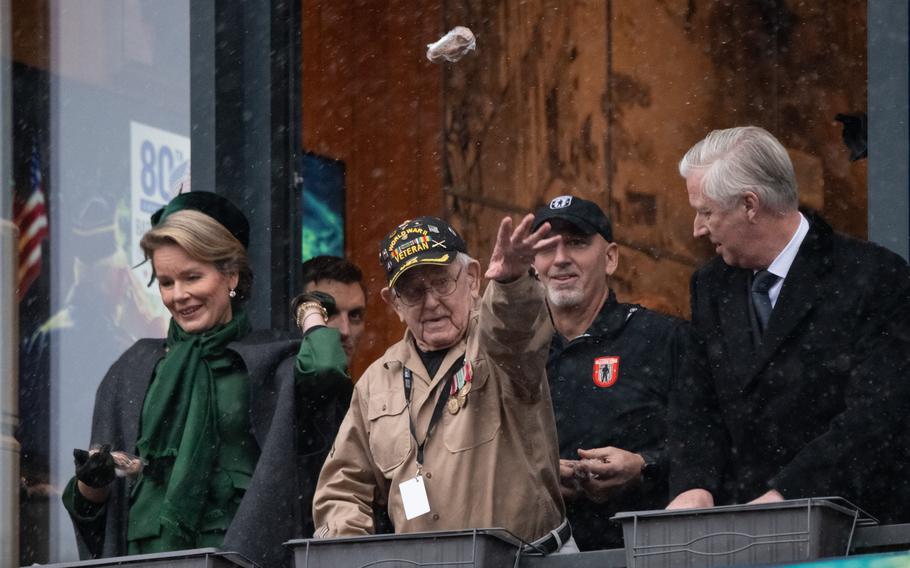
World War II veteran Dennis Bolt throws nuts to a crowd during Battle of the Bulge commemorations in Bastogne, Belgium, Dec. 14, 2024. He is joined by Belgium’s Queen Mathilde and King Philippe. (Phillip Walter Wellman/Stars and Stripes)
By late 1944, Allied forces had liberated most of France and were advancing toward Germany, but their supply lines were stretched thin. The Ardennes - rugged, forested, and lightly defended - was considered an unlikely axis for a major German attack. That assumption proved costly.
Three key struggles came to define the battle.
-
The Siege of Bastogne: Surrounded and outnumbered, the 101st Airborne Division held the vital road junction at Bastogne under relentless attack. General Anthony McAuliffe’s defiant reply - “Nuts!” - to a German demand for surrender became a symbol of Allied resolve.
-
St. Vith: Stubborn resistance here delayed the German timetable, buying invaluable time for Allied reinforcements and blunting the offensive’s momentum.
-
Patton’s Counterstroke: General George S. Patton’s Third Army executed a rapid and a rather brave pivot north, relieving Bastogne in a feat of logistics and command that helped turn the tide.
When the weather cleared in late December, Allied air power returned with devastating effect. German supply lines were shredded, fuel shortages became critical, and the offensive stalled. A determined Allied counterattack steadily pushed the Germans back toward their starting positions.
Men fought in temperatures that froze weapons, stiffened fingers, and turned the wounded into ice if help did not come.
The cost was immense. German losses exceeded 100,000 casualties and included tanks and aircraft Germany could not replace. American forces suffered nearly 90,000 casualties, including approximately 19,000 killed - the highest losses the United States sustained in any single battle of the war.
Although American troops bore the heaviest fighting - with over 600,000 U.S. soldiers committed - the battle was an Allied effort. British forces played a crucial role in containing the northern shoulder of the bulge under Field Marshal Montgomery’s command, while Belgian and Luxembourg resistance fighters provided intelligence and local support.
Australian and New Zealand forces were not involved, both nations being heavily committed to the war against Japan in the Pacific.
Yet the outcome in the Ardennes would shape the final months of the global conflict they were also fighting.
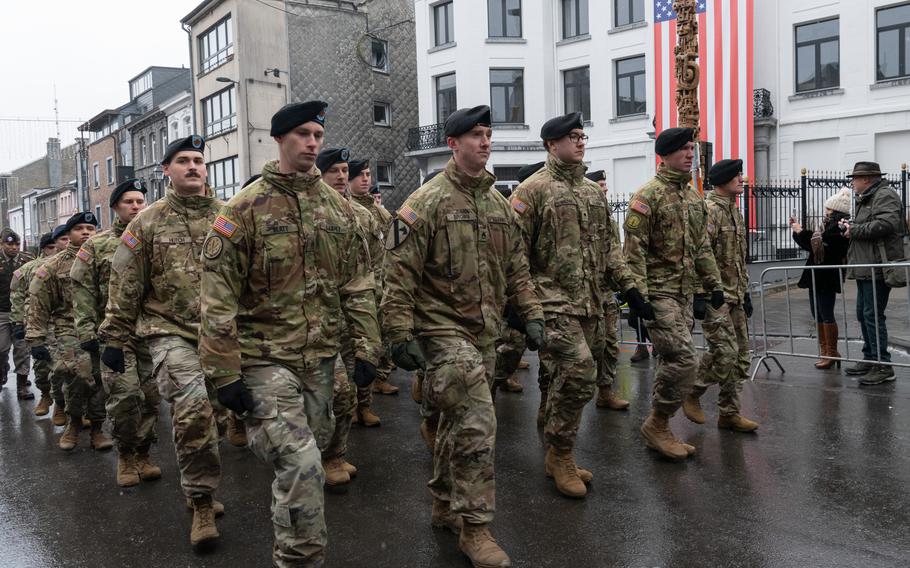
Active-duty U.S. soldiers parade through Bastogne, Belgium, Dec. 14, 2024, marking 80 years since the battle. (Phillip Walter Wellman/Stars and Stripes)
The Battle of the Bulge ultimately exhausted Germany’s remaining reserves and hastened the collapse of the Third Reich.
By spring 1945, Allied forces had crossed the Rhine and were advancing deep into Germany. Victory in Europe was no longer in doubt.


